A few years ago, the most convincing lie on the internet was often the one that came with a screenshot. Not a graph, not a dataset, not a leaked PDF. A screenshot. It felt like a receipt, a captured moment that could not be argued with. Your brain did the rest, filling in context, hearing the implied tone, remembering how a message thread looks on your own phone at 1:07 a.m.
That instinct still lives in us, but it is now living in a different neighborhood.
Today, the “receipt” is increasingly easy to manufacture. The internet has always had hoaxes and forged documents, but something has shifted in texture and speed. Synthetic content, whether it is a mocked-up chat, an AI-generated photo, or a tampered document, has turned ordinary people into informal forensic analysts. We squint at pixels. We zoom in. We ask for originals. We trade tips on what a real iPhone font should look like. And in the process, we quietly renegotiate what we mean by proof.
This essay is about that renegotiation, the messy social bargain of trust in an era when making something look real is cheaper than ever.
The screenshot used to be a shortcut to belief
The power of a screenshot isn’t technical. It’s cultural. A screenshot borrows the legitimacy of a familiar interface: the green and white of WhatsApp, the bubbles of iMessage, the clean geometry of a Slack thread. These interfaces are the new stationery. They signal authenticity the way a letterhead once did, long before most people could spot a forged signature.
If you spend time online, you can probably recall a moment when a screenshot changed the temperature of a conversation. A celebrity “DM” that turned into a scandal. A group chat excerpt that reframed a breakup. A workplace message thread that allegedly showed bias, harassment, or a sloppy cover-up. Even when you suspect it might be edited, your gut still reacts first. The screenshot arrives with the posture of evidence.
That posture is precisely why screenshot fakery matters. It isn’t only that fake content exists, it’s that it fits into our existing habits of interpretation. We have trained ourselves to read a chat bubble as unfiltered reality.
Manufacturing “receipts” is now a consumer feature
When people talk about fake content, they often jump straight to deepfakes, the cinematic stuff. But the workhorse of everyday deception is simpler: the chat screenshot.
A tool like fake whatsapp chat can produce polished mock conversations across a long list of platforms, not just WhatsApp but Instagram, Discord, iMessage, Telegram, Messenger, X, Slack, Signal, TikTok, Snapchat, LINE, Microsoft Teams, Tinder, Bumble, and OnlyFans. And the point is not solely fraud. These generators are used for memes, pranks, film and TV mockups, UX wireframes, classroom examples, storyboarding, content marketing, and social media skits. In other words, the same affordance that enables a bad actor also serves perfectly normal creative and educational needs.
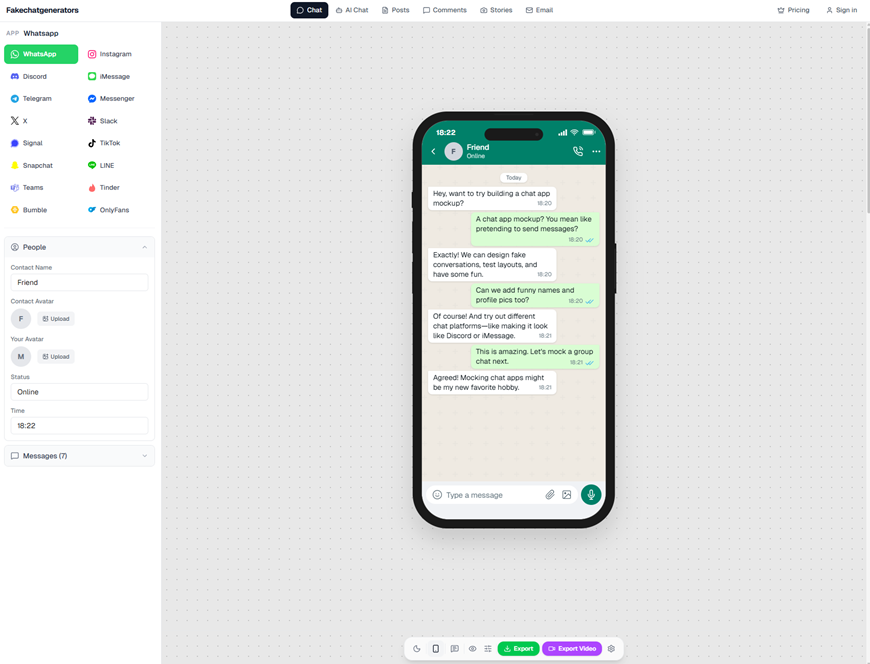
fakechatgenerators.com lets you mock up chat screenshots across 16 platforms
That dual-use reality makes the situation trickier than the usual morality play. The tool is not contraband. It is, in many contexts, just a faster way to illustrate a concept. A teacher might want to show students what phishing looks like without putting real names in a screenshot. A designer might need to storyboard how a messaging feature behaves. A comedian might build a punchline around a fictional group chat. The interface itself becomes a visual language, and these generators act like a keyboard for that language.
But once the keyboard exists, anyone can type a confession.
Context collapse meets interface credibility
The real damage often comes from context collapse: when content designed for one audience and interpretation leaps into another. A fake chat meant as a joke can be reposted without the caption, or cropped so the original framing disappears. A skit screenshot becomes “proof.” A storyboard becomes “leak.” The internet is good at stripping away intent.
This is also where platform design and human behavior collide. Social feeds reward content that is legible in half a second. A screenshot performs well because it looks like a fact. It is neat, self-contained, and easy to reshare. A long explanation, a careful caveat, or a “this is satire” label does not travel as fast. Meanwhile, the people most likely to encounter the screenshot secondhand are the least likely to have the surrounding context that would make it harmless.
It is tempting to treat this as a literacy problem, as if the solution is simply teaching everyone to be more skeptical. But skepticism has a cost. We only have so much attention, and constant suspicion is exhausting. So we outsource trust to cues. Familiar UI is a cue. A timestamp is a cue. A verified-looking profile photo is a cue. We build a quick internal verdict and move on.
Synthetic content attacks those cues directly.
The new arms race is not only about visuals
The story of synthetic media is often told as an arms race between creation and detection. That is true, but incomplete. The deeper contest is about social process: how claims are verified, who gets believed, and how quickly corrections can catch up to a viral narrative.
A fake chat screenshot can be disproven, but disproving it often requires extra steps that the original claim did not. You might ask for a screen recording. You might want the raw export. You might compare fonts and spacing against known versions of the app. You might examine whether the notch, battery icon, and time align with a specific phone model and operating system. You might notice subtle inconsistencies, like how a platform typically formats links, or whether read receipts are plausible given the story being told.
Each of these checks takes time and motivation. Meanwhile, the screenshot already did its work. It created an impression. It made people pick a side. And once people have picked a side, their appetite for forensic nuance drops sharply.
This is one reason synthetic content is so potent in interpersonal disputes. It is not just that the artifact can be faked, it is that the artifact can be used to pressure a quick judgment. “Look,” the screenshot says, “it’s right there.”
Detection tools arrive, but they cannot restore the old innocence
As synthetic images and manipulated documents spread, a parallel industry has grown around detection and verification. Some tools aim to identify whether an image was generated by a model, whether it has been edited, whether a document has been tampered with, whether content includes violence or NSFW material. They are designed for a range of users: journalists, trust and safety teams, banks, marketplaces, legal groups. The needs vary, but the theme is the same. The old “seeing is believing” shortcut is broken, and people want a replacement.
One example is an ai image detector that positions itself as a fast gatekeeper for media authenticity and safety. It claims 98.7% detection accuracy across more than 50 generative models, including Midjourney, DALL-E, Stable Diffusion, Flux, Ideogram, Google Gemini, and GAN-based outputs, with sub-150ms latency. Those numbers are pitched for real-world workflows, the kind where a moderation queue cannot wait minutes per file, or a newsroom cannot spend half a day debating whether a single image is synthetic.
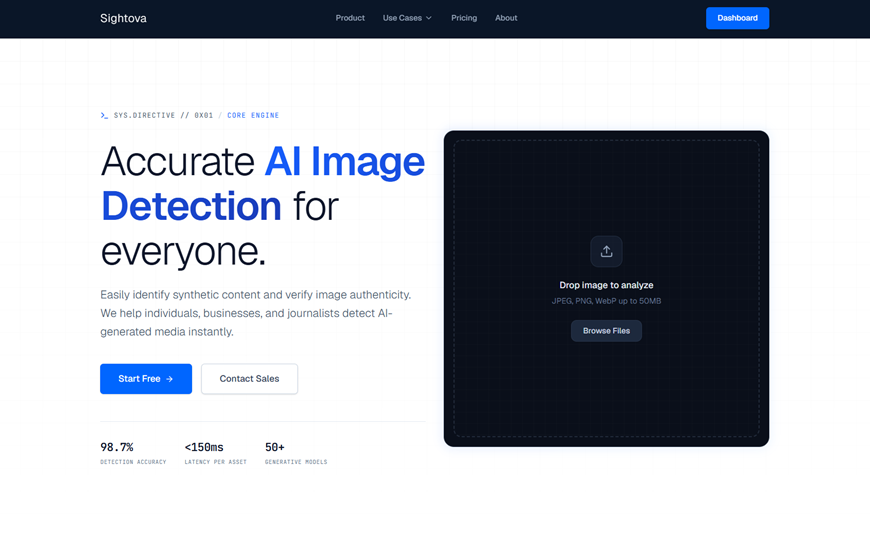
sightova.com flags AI-generated, tampered, NSFW, and violent imagery in milliseconds
But even if such tools work exactly as advertised, they don’t bring us back to the old world. Detection can answer a technical question, but trust is also emotional and social. A label that says “likely AI-generated” may not persuade someone who wants the image to be true. And a label that says “likely real” does not guarantee the context is honest, only that the pixels are not synthetic. Truth is more than provenance.
There is also a subtler problem: once detection becomes common, it can be used rhetorically. People will demand “proof” not because they are open-minded, but because they want to stall, or to cast doubt. Verification becomes another battlefield, another way to say, “Your claim doesn’t count until you meet my standard,” even when the standard keeps moving.
Trust has shifted from artifacts to systems
In the early web, trust was often anchored in artifacts. A photo was persuasive because it looked like a photo. A screenshot was persuasive because it looked like your phone. A PDF was persuasive because it looked like a document. Now, each of those artifacts is contestable. We have learned the hard way that the container is not the content.
So where does trust move? Increasingly, it moves to systems and reputations.
For journalists, that means process becomes part of the story. How was the image obtained? Who provided it? Was it independently confirmed? Were metadata and original files examined? What couldn’t be verified? These details used to be backstage. Now they are part of the public record, at least when editors are doing their jobs with care.
For platforms, it means building provenance into the pipeline, not just reacting after the fact. Some attempts focus on watermarking or cryptographic signatures. Others focus on friction, like requiring additional steps before a message can be forwarded widely. None of these are magic. But they reflect a recognition that “trust the artifact” is no longer viable.
For everyday users, it means leaning more heavily on social trust. You believe a screenshot because it came from a friend who has been reliable, or because multiple independent people corroborate the same account, or because the person accused responds in a way that feels like an admission. This is not ideal, since social trust can be manipulated too, but it is how humans operate when the evidentiary ground becomes unstable.
The quiet normalization of doubt
There is a psychological toll to living among synthetic artifacts. Not always dramatic, but cumulative.
If you suspect that any screenshot could be staged, you may become slower to empathize. If you suspect any photo could be generated, you may become slower to outrage. That sounds healthy, until it isn’t. Outrage can be misused, but so can apathy. Constant doubt can function like a sedative. It dampens the moral reflexes that drive people to defend others, to demand accountability, to correct wrongdoing.
This is the “liar’s dividend” effect in everyday life, even when no one uses the term. When fakes are common, real evidence can be dismissed as fake. The accused gets a new escape hatch. “That screenshot is fabricated,” they say, and sometimes the room shrugs because the claim is plausible. The burden shifts onto the person who brought the evidence, who must now prove the negative: not only that the event happened, but that the proof is not synthetic.
What’s new is not that liars lie. It’s that the ambient plausibility of forgery has risen.
When synthetic content is harmless, and when it isn’t
It matters to separate “synthetic” from “harmful.” A storyboarded chat exchange in a film pitch is synthetic, but it is not an attack on public trust. A classroom example that uses fake names and fictional messages is synthetic, and it may be responsible pedagogy. A meme that is obviously absurd is synthetic and, depending on taste, may even be funny.
The problem is that “obvious” varies by audience and context. The same image can read as parody to one person and as proof to another. Humor also has a habit of being weaponized. Someone posts a “joke” screenshot about a rival, and when it spreads, they can retreat to plausible deniability: Relax, it was satire. The harm, meanwhile, is already circulating.
There is also a spectrum of intent. Some fake chat screenshots are made for clout, to fuel a narrative, to trigger a pile-on, to damage a reputation, to manipulate a partner. Some are made to test a product or tell a story. The tool does not know which is which.
So the question becomes less about banning tools and more about building norms around disclosure. Film and TV mockups usually live in a controlled environment. A meme account may not. A content marketer might label a skit. A bad actor will not.
The burden of proof is migrating to the ordinary person
In previous eras, the “verification class” was smaller. Editors, courts, auditors, investigators. Now, people who never asked to be fact-checkers are expected to play the role. A teenager is asked to prove a message thread is real. A worker is asked to authenticate an HR email. A small business owner is asked to defend themselves against a doctored document. A moderator is asked to make a decision in seconds.
This migration is one reason the stakes feel personal. Synthetic content is not just a political problem or a platform problem. It is a neighbor problem, a coworker problem, a group chat problem.
It also changes what we consider a reasonable standard of evidence. A decade ago, a screenshot might settle an argument. Now, a screenshot may only start one. People ask for more: screen recordings, device captures, corroborating witnesses, additional messages that show continuity. In some cases, that’s a welcome upgrade. In others, it is unrealistic and punitive, especially for victims trying to document harassment or threats. The more we demand, the harder it becomes for genuine cases to be recognized quickly.
What a more resilient trust might look like
There is no return to a simpler internet where the screenshot is sacred. But trust can be rebuilt, just not by nostalgia.
A more resilient trust culture would probably include a few imperfect habits:
- Treat screenshots as claims, not conclusions. They can be leads, not verdicts.
- Look for continuity. Real conversations have awkward pacing, typos, interruptions, and context that extends beyond a single crop.
- Ask what would be hard to fake. Not impossible, just hard. A consistent set of files, verifiable metadata, independent corroboration, a chain of custody.
- Reward careful framing. Creators who label mockups, skits, or composites should be treated as responsible, not as killjoys.
- Use tools, but don’t worship them. Detection can reduce risk and speed up triage, but it cannot substitute for judgment about context and intent.
None of this is glamorous. It is slow and, at times, unsatisfying. It also runs against the grain of the feed, which wants speed and certainty.
But the alternative is worse: a public square where everyone assumes fabrication, where wrongdoing is easy to deny, and where the loudest narrative wins by default.
The internet didn’t lose trust overnight. It won’t regain it overnight either. Trust will return, if it does, through small acts of discipline and better systems, and through a willingness to say two sentences that feel increasingly radical: I don’t know yet. Show me more.